Thursday, June 30, 2005

Wednesday, June 29, 2005

Imaginary Books


The Invisible Library

The Invisible Library is a collection of books that only appear in other books. Within the library's catalog you will find imaginary books, pseudobiblia, artifictions, fabled tomes, libris phantastica, and all manner of books unwritten, unread, unpublished, and unfound.

Monday, June 27, 2005

According to Queeney


According to Queeney
Beryl Bainbridge's historical novel about the aging Samuel Johnson's relationship with the Thrale family could be a dry chronicle. Instead it's a witty depiction of life in eighteenth century England. Henry and Hester Thrale rescued Johnson, the literary giant, from the jaws of the black dog of depression. Did he love Hester? Bainbridge thinks he did. Hester nurses Johnson and pampers and cajoles him for 15 years although she herself lives a wretched existence with Henry, a lecherous philanderer and glutton who impregnates her 12 times (8 of the children die in infancy) and eventually eats himself to death. But, really, it's a very funny novel and skillfully written in the vernacular of the time and seen through the eyes of the Thrales' eldest daughter, Queeney, who grows up through the course of the novel. She views the adults around her with disdain and they do act awfully silly. The stories about Johnson's own home and the denizens who inhabit it are amusing. Their competition for his affection is a funny little sidebar to the novel. His kindness and understanding of the emotions of those unfortunates he adopts and provides for illustrates the depth of his character (he certainly treats his more privileged acquaintances with disrespect). There is a passage that describes what Mrs.Thrale's ailing mother, Mrs. Salusbury, sees as a snub by Dr. Johnson. While out walking with her family she becomes tired and sits on a bucket. Dr. Johnson happens along and, thinking that she is relieving herself, stumbles off awkwardly, trying to avoid causing her embarrassment. She can't fathom why he chooses to ignore her and suspects "that she was of no more interest to him than the stone urns set at frequent intervals along the way". It's a very funny moment. I read this book only because it got good reviews, in fact, Bainbridge was shortlisted for the Booker. I'm not a fan of historical fiction but this book made me laugh while I empathized with the tormented characters it portrays.

Saturday, June 25, 2005

The Early Show Summer Reading List

These look like perfect reads for the cottage or, in my case, the back yard. They're light and breezy and fun.

Guardian Short Stories

How wonderful is this? Short stories by some of my favourite authors: Richard Ford, DBC Pierre, Annie Proulx. There are even some I don't know: Carol Ann Duffy,Michel Faber, Julie Myerson. I couldn't read an entire book online but can handle the occasional short story. I'll save this link and refer to it when the weather turns cold and I can sit in front of the screen without feeling guilty.

Friday, June 17, 2005

They Are Not Amused


Haddon

Haddon finds the monarchy at odds with his vision as a writer. A key theme of The Curious Incident, he says, is the idea "that no human being is inherently inferior to any other. I felt it would have been hypocritical to meet with someone whose job involves being inherently superior to everyone else."

Phillips "believes passionately in the ability of healthy societies to take in and recognise those who are different from them; to enable them to rise to the top, without feeling there's only so far they can go". Haddon would "love to live in a society where no one is seen as inferior on account of who their parents are. But I don't think this is ever going to happen while we have a head of state who gets the job - and the frocks and castles - simply because their father had the job before them."

Wednesday, June 15, 2005

The Fruit Are So Delicious

The fruit are so delicious.
It makes me want to be vicious.

McSweeney's Review of New Food.

Sunday, June 12, 2005

The Kite Runner


The Kite Runner
The Kite Runner is the first book written in English by an Afghan author and this intrigued me. Most of what we read about Afghanistan is written by North American journalists who are looking at the country from a political point of view. We are shown what life is like for the privileged class before the Taliban came to power. Life was very comfortable indeed for people with money - somehow I never thought about wealth and Afghanistan in the same sentence. However, life has always been miserable for the poor there and it just keeps getting worse. This is the story of two boys, one rich, the other poor who are tied together by a bond much deeper than friendship. The wealthy boy, Amir, betrays his servant,Hassan. The book explores Amir's guilt and his search for redemption. Amir's desperate attempt to gain the love of his cold and distant father is also a key theme. I know that this book has attracted rave reviews but, in my opinion, the writing is formulaic and some of the prose is really hackneyed and old fashioned. Most of the characters, especially the villain in the story, are too one-dimensional to be believable. Nonetheless the story is a good one set in Afghanistan, The United States and Pakistan. Although The Kite Runner ends on a note of cautious optimism, it's disconcerting that the social, economic and religious conflicts portrayed in this book are even more widespread and devastating today.

Friday, June 10, 2005

Hear Your Favourite Authors

I discovered this site when I was looking for current info on Joan Didion. The audio adds a new dimension to one's perception of both the artist and the work.

Tuesday, June 07, 2005

Interactive Literary Map of Manhattan

The New York Times Book Review came up with this great interactive map. I've read a lot of these books; at one time I was fascinated by Manhattan and its sophisticated, elegant, exotic residents.

Sunday, June 05, 2005

All She Needs is Love


The Romantic
Honestly, that Louise! I want to slap her, or at least give her a good shaking. Her mother's abrupt abandonment of her and her father when she was just nine years old has left her desperate for love and fearful of more loss. In truth Louise never felt her mother's love although she tried so hard to win it - she memorises A Thousand and One Side-Splitters, index and all, because her mother, so distant and cold, is mildly amused by the jokes. Her mother looked like Grace Kelly and found it hard to believe that plain little Louise was her child, although she did enjoy shopping for her and dressing her up in exquisite outfits. Her dad refuses to believe that his wife has gone for good; he suspects that she's been conned by "some two-bit wheeler-dealer" and that it is only a matter of time until she returns, effectively preventing Louise from grieving or at least resolving their complicated relationship and moving on. She tries to fill the hole left by her mother's absence by imprinting on Mrs. Richter, a middle-aged, oddly dressed German immigrant. When she fails to get Mrs. Richter's maternal attention through posturing as a pathetic, neglected semi-orphan, she targets her adopted son, Abel Richter, and through her friendship with him weasels entry into their different sort of family. Abel is a tragic choice, he is the world's worst alcoholic on an unwavering self-destructive course. We don't know how he came to be this way, perhaps his life before he was adopted by the Richters was unspeakably horrible, perhaps genetics played a part? He is an addict and he loves his bottle more than he loves Louise, he may even love the twisted-faced denizens of the sleazy bars he frequents more than he loves her. He doesn't think she needs his love because he sees her as strong; he's wrong. Louise's singleminded yearning is terribly off-putting and pathetic ("Get over it, sister," I want to say. "He's not worth it.") but Gowdy's quirky, witty and understated writing kept me hanging in. I especially like the little 60's and 70's Toronto details that pop up from time to time. I find myself wondering whether the deaths of both targets of her infatuation will allow her to make a fresh, unencumbered start or will she, instead, search for another doomed attachment?
Wednesday, June 01, 2005

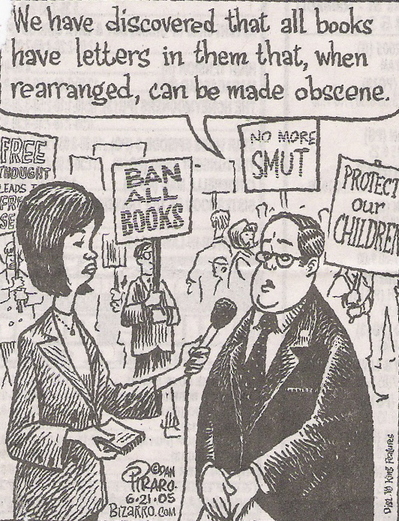
Ten Most Harmful Books of the 19th and 20th Centuries

At first I thought this was a joke! John Dewey encouraged the teaching of thinking skills to children - this is seditious? Betty Friedan's original vocation was not stay-at-home motherhood but left-wing journalism - wow, really dangerous. And this quote about Keynes :
When the business cycle threatens a contraction of industry, and thus of jobs, he argued, the government should run up deficits, borrowing and spending money to spur economic activity. FDR adopted the idea as U.S. policy, and the U.S. government now has a $2.6-trillion annual budget and an $8-trillion dollar debt.
I mean, does anyone believe that FDR is responsible for the Bushenomics debacle?

Online Human Events,a self -described national conservative weekly, has had a group of "scholars" and "public policy leaders" compile this list. What a load of claptrap!