Sunday, July 30, 2006
Field Tested Books Project


Saturday, July 29, 2006
Follies - Ann Beattie

In ten stories Beattie looks at baby boomers and the random encounters that change lives. I bought this book at the Book Depot and got it cheap because it was missing a dust jacket. Since the first story is more of a novella and not having read the dust jacket (which would have set me straight) I thought I was reading a novel and was completely thrown off balance by the second story which was, of course, a non sequiter. Once I figured out that I was reading a book of short stories and not a novel I settled in and enjoyed them. There are a few writers who make me jump for joy when I find their latest at The Depot: Ann Tyler, Joan Didion, Richard Ford, John Updike and Ann Beattie. Beattie speaks to people like me, she understands my dilemmas and addresses them with wit. Flechette Follies, the novella, seemed un-Beattie-ish and was my least favourite in the collection but I laughed out loud a few times while reading the other stories in the collection and felt compelled to share key phrases with my better half. Some wickedly good reading here, especially the last story, That Last Odd Day in L.A. where a curmudgeon finds redemption when he meets a deer.
Friday, July 28, 2006
Songwriter Leonard Cohen Discusses Fame, Poetry and Getting Older.
Uncensored 'On the Road' to be published
Thursday, July 27, 2006
Hear the Silence...

We are a small group of writers and designers who are long-time subscribers to the New Yorker. When the magazine arrives at our doorstep each week, we read the Talk of the Town section first - and not just because it is in the front. It is also because we adore the section's tone, subjects, and treatment. We adore them so much our spouses have started to worry and we've even submitted pieces to the TOTT ourselves. From there, well, it's just a short jog to the Silence of the City, a site dedicated to publishing stories once rejected by the Talk of the Town. Think of SOTC as an extension of TOTT, just with a different acronym and much less famous writers. The journalist Carl Bernstein (Garfunkel to Woodward's Simon), recently said: ' The wisdom of the ages cries out for silence.' We say: Amen.
Monday, July 24, 2006
Read, Rover, read

Being paw-sitively dog crazy, I'm game for increasing my canine Mugsy's cleverness and cuteness by teaching her to read.
Hey, no howls of laughter and ruff jokes allowed -- Teach Your Dog To Read (Random House), by Dr. Bonnie Bergin, is actually serious stuff. If dogs can detect bombs, sniff out cancer, sense the silent approach of a Tsunami and assist the disabled, then it seems plausible that a stupendous literary feat is just a leap away.
'Dogs are brilliant, perceptive beings ... they have an extraordinary capacity for learning,' says Bergin, who founded the service dog movement and has been training dogs to assist the disabled for more than 30 years.
It's a fetching concept: A revolutionary one, she says; one that'll further the evolution of interspecies communication and help dogs become smarter, better companions and play a greater role in daily activities.
Saturday, July 22, 2006
The New Yorker: Fact
Via Exploding Aardvark
10 flagrant grammar mistakes that make you look stupid - ZDNet UK Insight
No: I always loose the product key.
Yes: I always lose the product key.
#2: It's for its (or god forbid, its')
No: Download the HTA, along with it's readme file.
Yes: Download the HTA, along with its readme file.
No: The laptop is overheating and its making that funny noise again.
Yes: The laptop is overheating and it's making that funny noise again.
#3: They're for their for there
No: The managers are in they're weekly planning meeting.
Yes: The managers are in their weekly planning meeting.
No: The techs have to check there cell phones at the door, and their not happy about it.
Yes: The techs have to check their cell phones at the door, and they're not happy about it.
#4: i.e. for e.g.
No: Use an anti-spyware program (i.e., Ad-Aware).
Yes: Use an anti-spyware program (e.g., Ad-Aware).
Note: The term i.e. means 'that is'; e.g. means 'for example'. And a comma follows both of them.
#5: Effect for affect
No: The outage shouldn't effect any users during work hours.
Yes: The outage shouldn't affect any users during work hours.
Yes: The outage shouldn't have any effect on users.
Yes: We will effect several changes during the downtime.
Note: Impact is not a verb. Purists, at least, beg you to use affect instead:
No: The outage shouldn't impact any users during work hours.
Yes: The outage shouldn't affect any users during work hours.
Yes: The outage should have no impact on users during work hours.
#6: You're for your
No: Remember to defrag you're machine on a regular basis.
Yes: Remember to defrag your machine on a regular basis.
No: Your right about the changes.
Yes: You're right about the changes.
#7: Different than for different from
No: This setup is different than the one at the main office.
Yes: This setup is different from the one at the main office.
Yes: This setup is better than the one at the main office.
#8 Lay for lie
No: I got dizzy and had to lay down.
Yes: I got dizzy and had to lie down.
Yes: Just lay those books over there.
#9: Then for than
No: The accounting department had more problems then we did.
Yes: The accounting department had more problems than we did.
Note: Here's a sub-peeve. When a sentence construction begins with If, you don't need a then. Then is implicit, so it's superfluous and wordy:
No: If you can't get Windows to boot, then you'll need to call Ted.
Yes: If you can't get Windows to boot, you'll need to call Ted.
#10: Could of, would of for could have, would have
No: I could of installed that app by mistake.
Yes: I could have installed that app by mistake.
No: I would of sent you a meeting notice, but you were out of town.
Yes: I would have sent you a meeting notice, but you were out of town.
Today in Literary History
On this day in 1941, on his twelfth wedding anniversary, Eugene O'Neill presented the just-finished manuscript of Long Day's Journey Into Night to his wife, Carlotta, with a touching dedication. He later instructed his wife and his publisher that the play could not be printed until 25 years after his death, and not performed ever -- instructions which Carlotta overrode almost as soon as she got the chance.
Wednesday, July 19, 2006
LILEKS on Mickey Spillane
Mickey Spillane, an author I thought died long ago. He was not a graceful stylist - he wrote like someone ripping meat with a bent fork - but he exposed everything nasty and cruel in a genre that masked its grue behind wry and cynical turns of phrase. For that I suppose we should be grateful, since truth is always preferable to artifice, no? No. I'm bored by English drawing-room murder mysteries, but I prefer the aspirations and pretensions of Chandler. (The previous sentence was brought to you by an English major. Can you tell?) Spillane's sons are still at work - Shinder's bookstore downtown still has a rack of serial novels like The Executioner, but the genre is in decline. You look at the covers, read the summaries, and you hear the unoiled creak of a revolving rack in a bus station. There's a cheap suitcase at your feet, bound with twine. You're wearing a hat with a stained band. Seventeen hours to Peoria. A guy you knew in Korea said he might have a job for you.
You'll need something to read between here and there. Hell, it's all between here and there, when you think about it. You pass on the Hammett. You go for the Spillane. You don't like the part where the dame gets it, but you don't exactly skip it, either.
Tuesday, July 18, 2006
You call those nipples?
You pour it all into a poem: your skeleton, your bile, your oozing primordial remnant-your private parts. To be told that the fundamental you is not up to snuff-that's hard murder.
Spillane's last chapter
I thought this guy had been dead for years.
Sunday, July 16, 2006
THE GATE - Francois Bizot
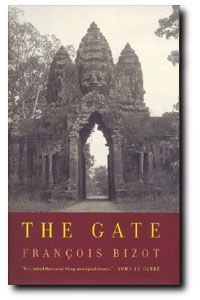
Francois Bizot was the only Westerner to survive imprisonment by the Khmer Rouge. Bizot arrived in Cambodia in 1965 to study Buddhism practiced in the
Cambodian countryside. He traveled extensively inside Cambodia, researching the history and customs of Cambodia's dominant religion. He spoke fluent Khmer,
French and English and was married to a Cambodian. When the Vietnam War spilled into Cambodia, Bizot was employed at the Angkor Conservation Office, restoring ceramics and bronzes.
In October 1971, Bizot and his two Cambodian colleagues were captured by the Khmer Rouge. During his captivity on charges of being a CIA agent at the Khmer Rouge Camp M.13 at Anlong Veng he developed a strangely close relationship with his captor, Comrade Duch, who later became the Director of the infamous Tuol Sleng concentration camp in Phnom Penh. During his 3-month imprisonment he came to understand the true genocidal nature of the Khmer Rouge long before other outsiders. He was finally released in December 1971 after Comrade Duch wrote a detailed report that convinced the Khmer Rouge leadership of Bizot's innocence. Bizot's Cambodian colleagues were executed soon after Bizot's release.
This is a restrained memoir, given the violence and horror of the events it covers. Much of the book focuses on Bizot's complex relationship with his captor, Douch, who later went on to commit the atrocities that we now associate with the Khmer Rouge time in power. Bizot avoids sensationalism and writes with great dignity about his ordeals. At times I found the book hard to follow and couldn't keep track of all the characters but I am glad that I stuck with it. In part I chose to read this book because a UN backed tribunal has just begun its investigation of the brutal Khmer Rouge regime and I wanted some background in order to have a clearer perspective when the inevitable atrocities emerge. Douch is one of those currently awaiting trial. It will likely take years to fit the pieces of this puzzle together. After all, it's taken 30 years for Bizot to sort out and come to terms with his own experience.
Friday, July 14, 2006
Today in Literary History
On this day in 1881 Billy the Kid was killed by his nemesis, Pat Garrett, at Fort Sumner, New Mexico. Near midnight, the Kid returned from an errand of love or hunger to find someone in his hideout; to his hushed 'Quien es? Quien es?,' Billy received a fatal shot above the heart. This was also the starting pistol for a fiction marathon which shows no signs of being over. . . .
Tuesday, July 11, 2006
Bulwer-Lytton 2006 Results
Detective Bart Lasiter was in his office studying the light from his one small window falling on his super burrito when the door swung open to reveal a woman whose body said you've had your last burrito for a while, whose face said angels did exist, and whose eyes said she could make you dig your own grave and lick the shovel clean.
Monday, July 10, 2006
Vladimir Nabokov. Transparent things
Here's the person I want. Hullo, person! Doesn't hear me.
Perhaps if the future existed, concretely and individually, as something that could be discerned by a better brain, the past would not be so seductive: its demands would be balanced by those of the future. Persons might then straddle the middle stretch of the seesaw when considering this or that object.
It might be fun. But the future has no such reality (as the pictured past and the perceived present possess); the future is but a figure of
speech, a specter of thought.
Hullo, person! What's the matter, don't pull me. I'm not bothering him. Oh, all right. Hullo, person . . .
(last time, in a very small voice).Via Grow a Brain
Sunday, July 09, 2006
The Ten Greatest Books About Rock And Roll
Every fledgling rock and roll fan goes through the same phase. Whether
passed down from an older sibling, a hipper friend or simply found on one's own, some time after getting your first real dose of classic rock, copies of No One
Here Gets Out Alive, the lurid Jim Morrison biography; 'Scuse Me While I Kiss The Sky, a tell-all about the legendary Jimi Hendrix and Legend, Tim White's well researched biography of Bob Marley, inevitably make their way into your
hands. However, as Bon Jovi once said, 'it's all the same, only the names have
changed.' The same decadent tales contained in the Led Zeppelin memoir Hammer Of The Gods are echoed in Danny Sugerman's Appetite For Destruction: The Days Of Guns N' Roses only to be retold in the chronicles of Motley Crue compiled in The Dirt: Confessions Of The World's Most Notorious Rock Band.
While there will always be an allure to tales of sex, drugs and rock and roll, especially amongst the high school set, stories of Satanism, sharks and groupies only present a small albeit colorful aspect of rock and roll. While any one of those
'unauthorized' tomes of 'literature,' may give a sense of the artist's origins and human failings, they rarely provide any perspective on the larger world of rock and roll.
What follows is a list, in no particular order, of the ten greatest books ever written about rock and roll. As you will see, it doesn't always have to be non-fiction to delve into the psyche of rock music, grasp the artistic essence of a generation or provide insight into the music that probably plays too large a role in some of our lives. It's only rock and roll, but we like it.
Friday, July 07, 2006
Today's Haul
 The Book Depot had a box sale today. I bought two boxes, mostly art books, for $60.00 and am about to sit down outside with a glass of wine and gloat over my haul.
Thursday, July 06, 2006
FRESH YARN Presents
By Tiffany Zehnal
'It's not denial. I'm just selective about the reality I accept.'
- Bill Watterson, author of Calvin & Hobbes
* * * * *
My childhood was nothing to write home about. It was neither extraordinary like Bobby Fischer's nor bleak like Frank McCourt's. I didn't play chess and never once took on an Irish accent. Not even on St. Patrick's Day when anybody with a mouth did. More or less, my childhood was just your basic, run-of-the-mill, generic kind. Like the ones you'd see on TV. But with less flattering light and an inferior kitchen set.
I remember it fondly.
MUNRO TO RETIRE?
Canadian literary icon Alice Munro is expected to announce at a Toronto fundraiser tonight that she has written her last book.
Munro is scheduled to give a reading at a benefit and book launch for Writing Life, a PEN Canada anthology of essays from 50 Canadian and international authors that is scheduled to hit stores July 1. In her contribution to the volume, Munro cites a tremor in her writing nerves in the face of constant interruptions and advancing age. (She will be 75 next month.) She says she can quit writing 'in the interests of a manageable life' and with the knowledge that it's rare for outstanding work to be produced in a author's later years, 'so one or two books fewer won't really be anybody's loss.'
Monday, July 03, 2006
Babar the Elephant turns 75
Babar the Elephant, a timeless figure of children's literature, turns 75 this year, his trademark crown and green suit unmarked by changing fashions and criticism that his jungle realm is a relic of colonialism.
Babar was created one evening in 1931 when Cecile de Brunhoff, a piano teacher, told her two small sons the story of an elephant whose mother is killed by hunters and who flees to a town where he learns to dress as a human.
Saturday, July 01, 2006
George Sand, Chopin
Doug Coupland's High School Confidential
The first two weeks in the abandoned school were Steven Kingy, but once the creepiness left it was like working inside my dreams at night, except it was real and I had control. I could literally, legally, artistically bash the crap out of anything that displeased me. At will I could mangle and trash lockers or AV equipment or uninspired textbooks. It was like being handed a superpower: the power to reconfigure the way I existed with my memories. Within a month, I was no longer having recurring dreams of trying to remember my locker combination or being late for a test in a class I didn't even know I was enrolled in. Gone. Thank you, art.
Nick Brooks: top 10 literary murderers
'Literary killers hold a deep fascination for us, taking grip of the imagination when other forms of writerly voyeurism have long since faded. During the writing of my own novel, The Good Death, a number of the works on this list occupied my thoughts, and I could easily have included many more novels and stories, settling instead for the ones that have been most influential on a personal level, the ones that stick with me still, many years after my first bruising encounters with them. It is no exaggeration to say that the characters who inhabit these works seem to exert an undue - possibly malign - power upon the psyche of the reader who stumbles, hapless, upon them. Since the best is often the enemy of the good, this list has been compiled with no particular order.'
Harper Lee breaks her silence in letter to Oprah
Published in the summer issue of Oprah's magazine, O, a rare item by the veteran author of To Kill A Mockingbird, Harper Lee, tells of her discovery of books as a girl growing up in a rural, Depression-era Alabama town.
The 80-year-old Pulitzer Prize winner stopped giving interviews about 40 years ago and, other than a 1983 review of an Alabama history book, has published nothing of significance in some four decades.
Lee tells of becoming a reader before first grade: she was read to by her older sisters and brother, a story a day by her mother, newspaper articles by her father. 'Then, of course, it was Uncle Wiggly at bedtime.'
She also writes about the scarcity of books in the 1930s in Monroeville, where she grew up and still lives for part of the year. That deficit, combined with a lack of anything else to do - no movies for kids, no parks for games - made books especially treasured, she writes.
'Now, 75 years later in an abundant society where people have laptops, cell phones, iPods and minds like empty rooms, I still plod along with books.'