
Monday, October 30, 2006

BibliOdyssey: Ragtag and Whimsy


Anagram Bookshop (Prague) promotional images
from Kaspen (alas, no more bookish fare, but they
have a nifty flash site and quite a portfolio of work).

Via Neatorama

Sunday, October 29, 2006

The Cadence of Grass


It's been quite awhile since I've read one of Thomas McGuane's testosterone fueled novels. It's short but a lot of crazy stuff happens: death, organ theft, illegal cremation, suicide and
murder. I skipped over much of the descriptions of horses and cattle and their various accoutrements and activities just
because I found those passages boring. Paul is the typical McGuane tough guy and a bit of a loser, yet still attractive to the two central and very dysfunctional female characters. He also appeals to his probation officer but this involvement ends badly.
There's a wise and kind old cowboy, a cross-dressing rancher
and a nasty deceased patriarch. Said patriarch left an improbable will that drives the story.
The Cadence of Grass was published a full 11 years after his last work of fiction Nothing But Blue Skies and I can't say it was worth waiting for. I read it quickly, mostly because I skipped the horsey bits and somehow I managed to squeeze some satisfaction out of what is, I think, a work without much substance. Read it if you really like McGuane; otherwise give it a wide berth.

The Stranger in Crawford

Albert Camus (1913–1960) has been much in the news over the past 12 months. In Camus’ birthplace of Algeria, where the nation’s post-colonial rulers have long viewed him with suspicion and antipathy, the University of Algiers (in what Le Monde described, in exquisite franglais, as “un come-back étonnant”) organized a state-sponsored conference dedicated to Camus’ impact on Algerian literature. On the other side of the Mediterranean in France, the Gallimard publishing house brought out the first two volumes of a new and expanded critical edition of Camus’ complete works in its prestigious Pléiade series. Meanwhile, across the Channel in Britain, Camus’ famous 1942 novel of alienation, L’Etranger (The Stranger) came out on top in a Manchester Guardian poll conducted among male readers asked to name the book that had most “changed their lives.” But all of this paled in significance to the event that truly launched Camus’ return to the spotlight in 2006: the announcement by White House Press Secretary Tony Snow that President Bush had read The Stranger while vacationing in August at his ranch in Crawford, Texas. "

Friday, October 27, 2006

Today In Literature

Jacob's Room
On this day in 1922 Virginia Woolf's Jacob's Room was published. This was the first full-length book put out by the Woolfs' Hogarth Press, with a Post-Impressionistic cover designed by sister Vanessa. It was 'a new form for a new novel,' wrote Woolf before starting; afterwards, she felt confident 'that I have found out how to begin (at 40) to say something in my own voice,' and that 'Either I am a great writer or a nincompoop.'

Wednesday, October 25, 2006

We will soon be lost for words

In the final exclusive extract from his new book on language, John Humphrys laments the death of formality and the dumbing down of classic texts.

Saturday, October 21, 2006

Today In Literary History


For Whom the Bell Tolls
On this day in 1940 Ernest Hemingway's For Whom the Bell Tolls was published. It had been over a decade since A Farewell to Arms, and though there had been a handful of books during that time, the critics had not thought much of them. About this one, many agreed with Edmund Wilson: 'Hemingway the artist is with us again; and it is like having an old friend back.'

When This is Over...

FRESH YARN presents When This is Over... by Karen Rizzo:
Jim, tell me something comforting.' I say to my husband, as I lay in bed staring at the ceiling.
'Okay.' He puts down his book. 'We don't really exist.'
Not quite what I had in mind.

I fall off to sleep and dream of my father being chased by a police car. The siren on the car interrupts my sleep, then morphs into a muffled, wailing cry. Is it Drake, my five-year-old, in the midst of a nightmare? A feral parrot with its acute imitation of a child in distress? The baby's monitor? My father's monitor? It's 3 a.m. and it's the baby, August. Jim is either sleeping or feigning sleep or has left his body on a sojourn to another dimension. Two hours ago we gave Dad his morphine for the night.

Friday, October 20, 2006

The Story of Lucy Gault


This is a lovely book, quiet in the same way as Chatwin's novel "On the Black Hill". Lucy Gault is 8 years old in 1921. A violent incident at the Gault family estate leads her parents to the difficult decision to leave Ireland. Lucy overhears her parents discussion and can't bear the thought of leaving her idyllic existence; she runs away in a misguided attempt to convince her parents to remain at Lahardane. Her action shapes the novel and the lives of all the characters in it. Everything that happens from then on is a consequence of Lucy's childish impulse. Chance plays a major role. Her parents find an article of her clothing abandoned on the shore and believe that she has drowned. Devastated beyond bearing, they leave Ireland and all reminders of it behind. If only Lucy's parents had remained a few more days in Ireland or had searched the woods they would have found her and avoided a lifetime of guilt and recrimination. It's so terribly sad but it is beautifully written and, I think, William Trevor's best novel.

Wednesday, October 18, 2006

Stairway To Heaven

:
It was a perfect African night, straight out of Conrad: the air was pasty and still with humidity; the night smelled of burned flesh and fecundity; the darkness outside was spacious and uncarvable. I felt malarial, though it was probably just travel fatigue. I envisioned millions of millipedes gathering on the ceiling above my bed, a fleet of bats flapping ravenously in the trees below my window. But the most troubling thing was the ceaseless roll of drums: a sonorous, ponderous thudding that hovered around me. Whether it meant war, peace, or prayer, I couldn’t tell
The New Yorker: Fiction

Friday, October 13, 2006

Ottawa couple has self-help books covered


An Ottawa couple is selling book jackets bearing unusual self-help titles, challenging those who might judge a book by its cover.
How to Murder a Complete Stranger… And Get Away with It and The Nutritional Benefits of Nose-picking are a few of the 20 titles Michelle and Brian Watters have come up with since they started their book jacket business, FlapArt Inc.


Why, you ask?
"If you want to sit by yourself, and you don't want anyone bothering you, Perfecting the Art of Fart Projection will guarantee you a solo seat," she said jokingly, although she admitted the potty humour might not appeal to everyone's taste.

Thursday, October 12, 2006

A Roddy Doyle Treat via The New Yorker

Getting older wasn’t too bad. The baldness suited Martin. Everyone said it. He’d had to change his trouser size from 34 to 36. It had been a bit of a shock, but it was kind of nice wearing loose trousers again, hitching them up when he stood up to go to the jacks, or whatever. He was fooling himself; he knew that. But that was the point—he was fooling himself. He’d put on weight but he felt a bit thinner.
There were other things, too, that had nothing to do with his body and aging. The kids getting older was one, and the freedom he’d kind of forgotten about. For years, if he stayed in bed in the morning, if he wanted to, it had to be carefully planned. Lizzie, his wife, had to be told. The kids had to be told, and nearly asked. It hadn’t been worth it, the fuckin’ palaver he’d had to go through. For years, all those years the kids were growing up, he’d been on call. A pal of his had used the phrase, on call. He’d been talking about his own life, but—there were four of them there that night in the local, sitting around one of the high tables—he’d been describing all their lives.
—I’m like a doctor without the fuckin’ money, Noel had said.

Shelfari

The problem with our large bookshelves is that they are buried in our home where only a subset of people can see what we have read. Now with Shelfari you can show off that book collection to your friends and the world!

Wednesday, October 11, 2006

Algonquin Round Table

The period that followed the end of World War I was one of gaiety and optimism, and it sparked a new era of creativity in American culture. Surely one of the most profound -- and outrageous -- influences on the times was the group of a dozen or so tastemakers who lunched together at New York City’s Algonquin Hotel. For more than a decade they met daily and came to be known as the Algonquin Round Table. With members such as writers Dorothy Parker, Harold Ross (founder of THE NEW YORKER) and Robert Benchley; columnists Franklin Pierce Adams and Heywood Broun, and Broun’s wife Ruth Hale; critic Alexander Woollcott; comedian Harpo Marx; and playwrights George S. Kaufman, Marc Connelly, Edna Ferber, and Robert Sherwood, the Round Table embodied an era and changed forever the face of American humor.

Kiran Desai wins Booker

Indian writer Kiran Desai won Britain's prestigious Man Booker Prize yesterday for The Inheritance of Loss, a cross-continental saga that moves from the Himalayas to New York City.
Desai, daughter of novelist and three-time Booker Prize nominee Anita Desai, had been one of the favourites for the £50,000 ($105,000 Canadian) prize."

Sunday, October 08, 2006

Margaret's books sold by boxful

I just went to a lecture about the auction of Margaret's jewellery and art. Those went for well above what was estimated.

In some ways the revelation of the contents of Princess Margaret's bookshelves, from her apartment at Kensington Palace, were more achingly personal than the tiaras and monogrammed linen sold at a Christie's auction last summer.
Yesterday her books were brutally described by the specialist auction house Bloomsbury as 'mainly country house rainy day reading', and boxed up in lots of up to 100 books, estimated at less per volume than the price of a magazine.
Today In Literary History

On this day in 1931 Virginia Woolf's The Waves was published. She was just forty-nine, and she would live and write for another decade, but this was the last of her major works. Many also say it is the best, and when Leonard Woolf put a memorial plaque in the garden of their home, he chose from among its last lines: 'Death is the enemy. Against you I will fling myself, unvanquished and unyielding, O Death!' The waves broke on the shore."

Zoe Williams on Jonathan Franzen's new memoir

When Jonathan Franzen published his bestselling novel The Corrections, readers wondered how much it owed to his own life. Does his new memoir tell us any more about the man? Zoe Williams meets him .

`Libraries abhor a vacuum'

In this article in today's Toronto Star Alberto Manguel addresses one of my most pressing problems: book storage. I fear I may end up like the unfortunate individual below.

Shortly after Christmas 2003, a 43-year-old New York man, Patrice Moore, had to be rescued by firefighters from his apartment after spending two days trapped under an avalanche of journals, magazines and books that he had stubbornly accumulated for over a decade. Neighbours heard him moaning and mumbling through the door, which had been blocked by all the paper. Not until the lock was broken with a crowbar and rescuers began digging into the entombing piles of publications was Moore found, in a tiny corner of his apartment, literally buried in books. It took over an hour to extricate him; 50 bags of printed material had to be hauled out before this constant reader could be reached.


Excerpted from The Library at Night by Alberto Manguel

Saturday, October 07, 2006

Poem of the Month

Each month, TATE ETC. publishes new poetry by leading poets such as John Burnside, Moniza Alvi, Adam Thorpe, Alice Oswald and David Harsent who respond to works from the Tate Collection.
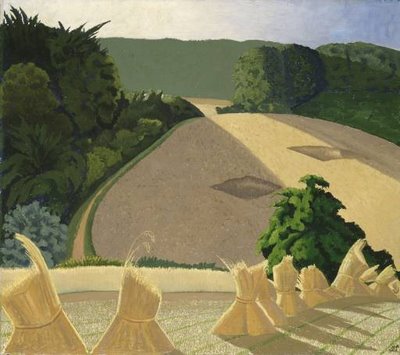
The first poem to appear is John Burnside’s beautiful meditation on John Nash’s evocative wartime landscape The Cornfield 1918, currently on display at Tate Liverpool.

CORNFIELD
After Jon Nash
Nothing is as it was
in childhood, when we had to learn the names
of objects and colours,
and yet the eye can navigate a field,
loving the way a random stook of corn
is orphaned
- not by shadows; not by light -
but softly, like the tinder in a children’s
story-book, the stalled world raised to life
around a spark: that tenderness in presence,
pale as the flame a sniper waits to catch
across the yards of razor-wire and ditching;
thin as the light that falls from chapel doors,
so everything, it seems,
is resurrected;
not for a moment, not in the sway of the now,
but always,
as the evening we can see
is all the others, all of history:
the man climbing up from the tomb
in a mantle of sulphur,
the struck match whiting his hands
in a blister of light.

Friday, October 06, 2006

Spoiler Warning

The Endings of 10 Famous Novels You Always Meant to Read but Never Got Around To.
BY SALOM TESHALE
- - - -
She dies.
He falls out of love with her.
He dies.
He kills it and then he dies.
Everyone dies.
A fire destroys everything.
He wins.
They're rescued.
They find it.
Snape kills Dumbledore.

Wednesday, October 04, 2006

I Like You: Hospitality Under the Influence by Amy Sedaris

I can hardly wait to read it!
'Sedaris's sidesplitting guide to throwing parties hopes to return readers to the times when the word entertainment was 'charmingly old-fashioned, like courtship or back alley abortions.' While her tongue is firmly in cheek, novice party-planners will actually find some helpful hints along the way as Sedaris offers instructions and real recipes. Her tips run the gamut from how to properly freeze meatballs (freeze them on a cookie sheet before putting them into a freezer bag so they won't stick together) and deal with the inebriated ('Better to cut them off rather than pretend it's not happening and then allow them to stay over and wet your bed'). She's a generous but crafty hostess ('A good trick is to fill your medicine cabinet with marbles. Nothing announces a nosey guest better than an avalanche of marbles hitting a porcelain sink'). Etiquette pointers include inappropriate introductions ('This is Barbara, she can't have children') and things to avoid saying to the grieving ('Did she smoke?' 'Was he drinking?' 'Where were you when this happened?'). Her advice is both practical and hilarious; her instructions on removing vomit stains ends with 'or just toss it, chances are you've stained it before.' Sedaris's first solo effort (after Wigfield with her Strangers with Candy co-stars, as well as several plays with her brother, David) is an outrageous and deadpan delight, greatly enhanced by her deliriously kitschy illustrations and photos.'

The romance is gone

The romance is gone
The chest has been rippled,
the bodice ripped;
the manhood’s been handled,
the sailor shipped.
Oh, Harlequin, Harlequin,
you illiterate clown!
You cut loose your jib
when the profits went down.
Stop all the washers,
fold all the clothes;
cry horny housefraus,
the doors have been closed.
Oh, Harlequin, Harlequin,
Queen of the dross!
What hope for your readers
on stormy seas tossed?
Once more in the breeches,
the pirate lord cries;
while the maids he beseeches
wipe tears from their eyes.
Hey, I just made that up! Next stop, Harlequin! Oh wait. They’re laying off people like me. Does this mean there will be four percent less heaving bosom? Four percent less hard manhood? Sigh. I don’t know if Fabio can have four percent less without being diagnosed with a condition.

Tuesday, October 03, 2006

Littourati

Literature often describes places we are curious about, regardless of whether we know them or not. This blog maps the journeys laid out in selected books and offers reflections corresponding to the various stops.

Tomcat In Love


The only other Tim O'Brien novel I read was the very dark In the Lake of the Woods. Tomcat In Love is a horse of a different colour - still lots of angst but with a farcical twist.
Tomcat is Thomas Chippering, professor of linguistics and wannabe ladies man. He spends much of the book trying to exact revenge on his faithless wife, the tycoon for whom she left him and her brother with whom she has a suspiciously cozy relationship. When he's not playing the avenger he plays the lech with many young women, all of whom are manipulators in their own right who consistently make the hapless Chippering pay tenfold for his lustful advances. It's funny, he's an amusing character but I thought it ran on too long in parts and could have benefitted from more disciplined editing. Every time I was tempted to set it aside I'd read some particularly witty bit and had to continue on. Chippering is a ludicrous character, very over the top, but he grows on you. I felt he got his just desserts when he was spanked by his enemies in front of his students yet I was pleased when the resolution seemed to be a positive one for him.